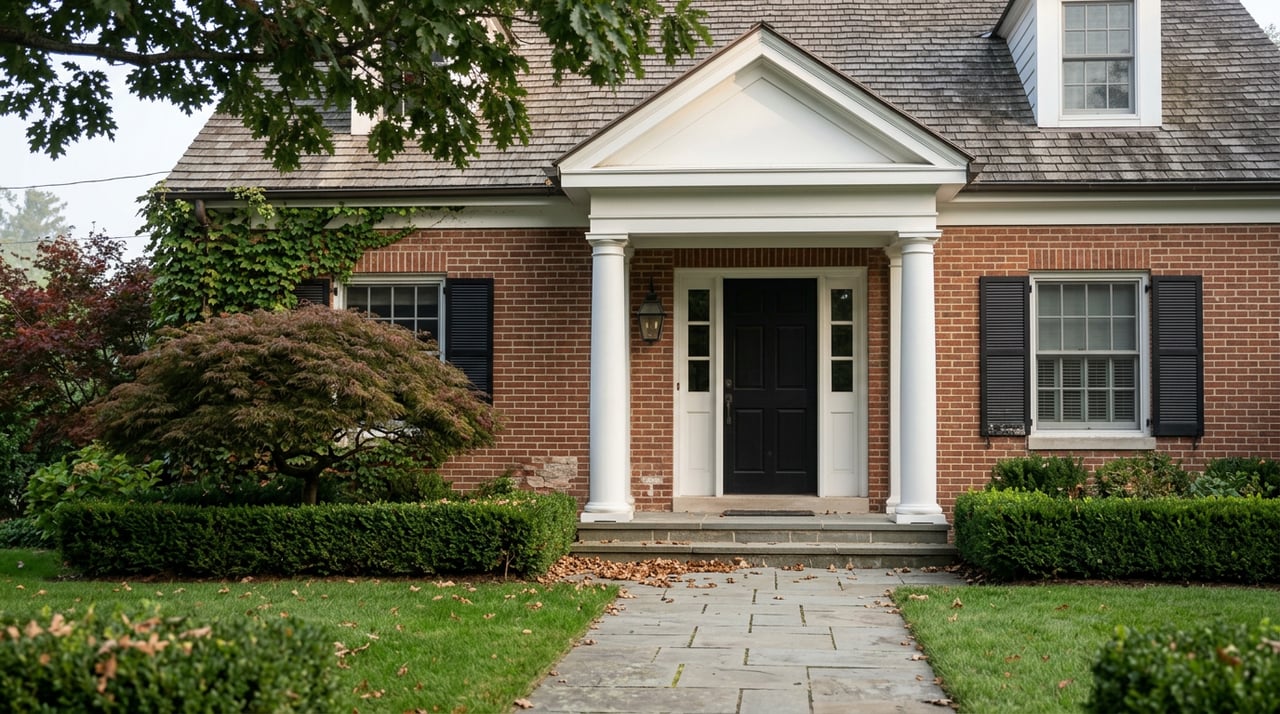
The People Rebuilding Roslyn Already Live Here
September 10, 2026
September 10, 2026
Drive into the Village of Roslyn from Old Northern Boulevard this month and the first thing you pass, right alongside the clock tower, is a movie marquee with no movie playing. The old four-screen theater on Tower Place has sat dark since the pandemic, but for the first time in four years the building looks like something is actually happening inside it. That small detail turns out to be the thread that connects almost everything that changed in this village over the past year.
Look closely at who is behind each of these projects and a pattern shows up that doesn't get said out loud very often: the people remaking downtown Roslyn in 2026 are, almost without exception, people who already live here or grew up ten minutes away. This isn't a story about outside capital discovering a cute Long Island village. It's a story about a place fixing itself from the inside, one building at a time, by people who already knew what these buildings meant before they touched them.
The Roslyn Cinema closed during COVID and stayed closed for four years, a familiar kind of vacancy on a Main Street. What's different here is who bought it. Kevin Dursunyan and his wife Margaret, both residents of the village, purchased the roughly 9,000-square-foot building and are converting it into a single-tenant retail space rather than carving it into smaller units. The renovation keeps the bones that made the building recognizable, a redone marquee, restored poster boxes, and a preserved projector room enclosed in glass, while gutting and modernizing the interior across its two floors.
Dursunyan has been direct about why the building mattered enough to buy rather than just develop.
"We wanted to save its integrity but bring it up to a modern space where it could be utilized as retail."
That instinct, to renovate around what's already there instead of erasing it, matches what's been happening on the surrounding blocks. The Dursunyans have pointed to Van Leeuwen, Sweet Harbor Coffee, and Okaru as recent additions to Roslyn's downtown retail mix, businesses the cinema project is meant to complement rather than compete with. Parking remains an open question the developers haven't resolved yet, which matters in a village where every new storefront runs into the same fixed number of spaces along Old Northern Boulevard and Main Street.
A few doors down, the space that used to hold Limani Mezze at 1512 and 1514 Old Northern Boulevard has a new tenant with its own local backstory. Chef Pasquale Abbatiello brought his proposal for a farm-to-table restaurant called Griffin to the Village of Roslyn Board of Trustees in February, and the board approved it during its February 17 meeting under Mayor John Durkin and Deputy Mayor Marshall Bernstein.
Abbatiello is a Long Island native who had spent recent years overseeing multiple restaurants in Westchester County. He told the board he was returning closer to home after the birth of his twins, and that Roslyn's access to Long Island's agricultural resources made it the right fit for a seasonal, locally sourced menu. Griffin opened in mid-April with a global concept menu that ranges from buttermilk biscuits and mussels a la plancha to schnitzel with chicory-arugula salad and dry-aged steaks, seating 94 across the dining room and bar.
The zoning details tell you something about how deliberately this was planned around the realities of a small village block. Employees park in the lower garage rather than the main lot. Deliveries route to the rear of the building and into the basement to avoid blocking Old Northern Boulevard. The restaurant runs primarily on a reservation-based system specifically to manage parking impact and customer flow, a choice Abbatiello framed around comfort rather than volume: "We don't necessarily want people walking into a packed restaurant." For a chef who could have opened almost anywhere, the decision to build around Roslyn's actual constraints, instead of asking the village to accommodate him, echoes the same instinct behind the cinema renovation two blocks away.
The most visible long-term project in the village isn't a new business at all. It's the Roslyn Grist Mill, a Dutch-framed watermill built in 1698 at the head of Hempstead Harbor, closed to the public since 1974, and now in the middle of a restoration that has been running for more than a decade under the Roslyn Landmark Society.
The pace of that work picked up noticeably this year. The cedar shingle roof was completed in November 2025, crafted to match the mill's original 18th-century materials. Since then the Landmark Society has been working through the exterior siding one wall at a time: the west side finished, window framing done, the north side underway as of early summer, with the east side left before the mill's exterior finally matches how it looked when it was first built more than three centuries ago.
Money has mattered as much as craftsmanship here. Nassau County Executive Bruce Blakeman delivered a second $1 million installment of a $2 million capital plan award to the project on April 24, part of a funding mix that also includes New York State grants and the federal Save America's Treasures program. Landmark Society co-president Howard Kroplick, who has led the organization through most of this restoration, described what that funding actually unlocked: "This has really enabled us to finish up phase two of this project and even start phase three."
Here's the part of this story with an actual clock attached to it. The Grist Mill is one of 26 sites in the 2026 Long Island History Hunt, a region-wide event tied to the 250th anniversary of the American Revolution and sponsored by the Robert David Lion Gardiner Foundation. The hunt runs from May 23 through September 30, which means it closes at the end of this month.
A few things worth knowing if you haven't already registered:
Registration runs through LIHistoryHunt.com. Given that the mill's exterior work is still visibly in progress, this is a rare window to see a 300-year-old building mid-restoration rather than after a ribbon cutting, which is its own kind of interesting if you've walked past the site for years without ever getting a look inside the fence.
The last piece of this year's Roslyn story is quieter but tells you something about how the village plans to keep doing this kind of work. In May, Howard Kroplick stepped down as co-president of the Roslyn Landmark Society after more than seven years leading the organization, a tenure during which membership grew from roughly 30 people to more than 300. The board elected Jordan Fensterman and John Santos as the new co-presidents. Fensterman has already been active in preservation work around Cedarmere, the former estate of poet William Cullen Bryant, as well as the Grist Mill itself.
The board also appointed Michelle Bounaix as a trustee. Bounaix grew up in Roslyn, left, and returned to the area in 2020. She works in architectural products and international construction, and described her view of preservation in terms that match everything else happening in the village this year: protecting what makes the community distinctive while allowing it to grow. Kroplick isn't disappearing either. He's staying on the board and remains involved in both the Grist Mill project and the ongoing restoration of the Mackay Estate Gate Lodge.
None of these five stories were planned together. A restaurant approval, a cinema renovation, a construction funding announcement, a nonprofit leadership transition, and a seasonal scavenger hunt don't usually belong in the same conversation. But look at the names attached to each one and the village starts to look less like a place being developed and more like a place being tended, mostly by people who already had a key to it.
If you're watching these changes unfold on your own block and wondering what they might mean for your property or your plans, Limor Karudo & Elimor Kochavi know this village from the inside too. Reach Out anytime you want to talk through what's actually happening on your street.
Stay up to date on the latest real estate trends.
As lifelong friends and trusted real estate partners, we combine creative vision, technical expertise, and genuine care to deliver a thoughtful, relationship-driven experience that helps every client feel confident from beginning to end.

LIMOR KARUDO AND ELIMOR KOCHAVI TEAM
[email protected]
LIMOR KARUDO: (516) 263-7075
ELIMOR KOCHAVI: (516) 225-9146
ADDRESS
49 BRYANT AVE
ROSLYN, NY 11576